Papers
Published
Public Support for Climate Policies: Costs, Redistribution, and Ideological Divides
West European Politics (2026). https://doi.org/10.1080/01402382.2026.2701769
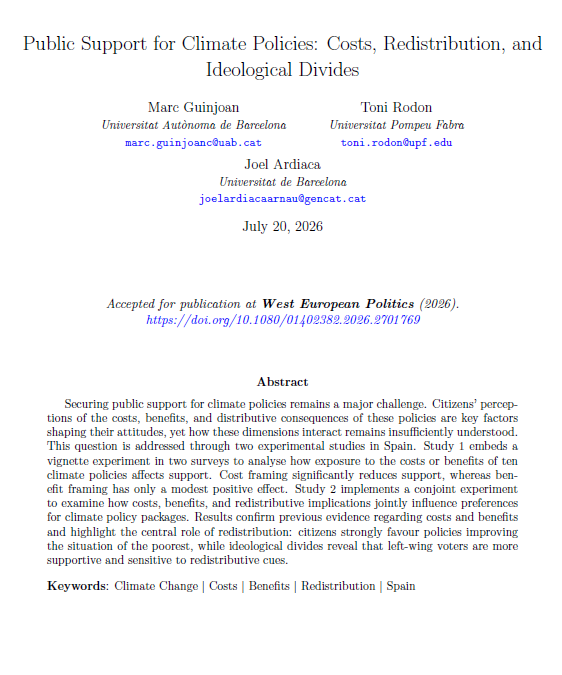
Despite broad public acknowledgement of climate change as a serious problem, support for specific mitigation policies remains limited and contested. This paper argues that the perceived costs of a policy, its anticipated benefits, and its distributive consequences jointly determine whether citizens support or oppose climate measures — dimensions that existing research has studied in isolation.
The authors address this through two experimental studies in Spain. Study 1 tests how exposure to the costs or benefits of ten specific climate policies affects stated support: cost framing significantly reduces support, while benefit framing produces a more modest positive effect. Study 2 implements a conjoint experiment allowing respondents to trade off costs, benefits, and redistributive implications in evaluating climate policy packages.
The conjoint results show that redistribution plays a central role: citizens strongly favour policies that improve the situation of the poorest, suggesting potential coalition-building strategies around eco-social policies. Ideological divides are substantial: left-wing voters are more supportive overall and more sensitive to redistributive cues, while right-wing voters are particularly responsive to cost framing.
The Limits of Alarm: How Climate Scenarios Fail to Increase Willingness to Act and Pay for Climate Change Policies
Political Studies Review, Vol. 24(2), pp. 325–334 (2026). https://doi.org/10.1177/14789299251399359
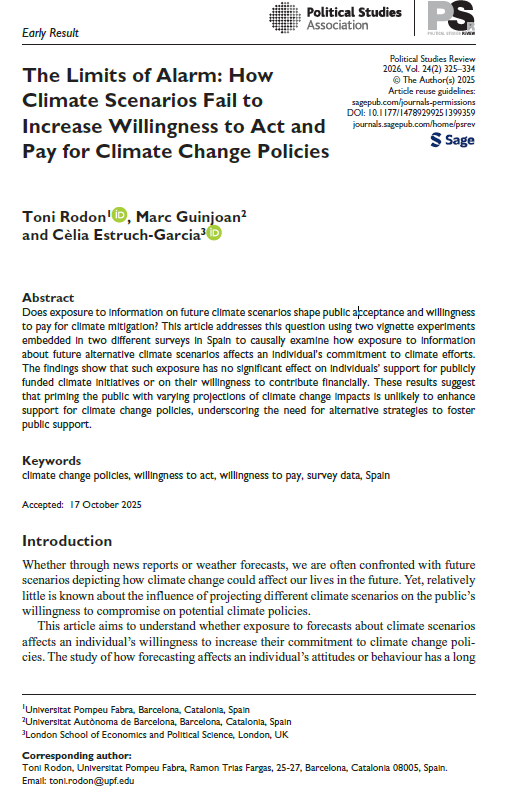
A widespread assumption in climate communication is that confronting the public with vivid projections of future climate scenarios will increase their support for mitigation policies. This article puts that assumption to a rigorous empirical test. Using two vignette experiments embedded in representative surveys of the Spanish population, the authors causally examine whether exposure to information about alternative climate scenarios — ranging from moderate to catastrophic — affects citizens' commitment to climate action in two key dimensions: their support for publicly funded climate initiatives, and their willingness to contribute financially.
The experimental results are strikingly null. Across both surveys and both outcome measures, exposure to future climate scenario information has no significant effect on individuals' willingness to act or to pay. This finding holds across different ideological groups: left-wing and right-wing respondents alike are unaffected by the climate scenario treatments. The authors rule out a range of alternative explanations, including ceiling effects and floor effects, finding that the null result is robust and not an artifact of sample composition.
The article challenges the prevailing assumption that fear-based or risk-based messaging strategies can generate the political will for ambitious climate policies, and suggests that alternative approaches — centred on co-benefits, social norms, or collective framing — may be more effective in building public coalitions behind climate action.
Healthier, Not Just Greener: Public Response to Different Benefit Framings in Carbon Tax Support in Spain
Electoral Studies. Accepted for publication.
Efforts to implement climate policies often face public resistance. This study, based on a pre-registered survey experiment in Spain (N = 2,768), tests how different framings of carbon taxation — emphasizing costs, primary climate benefits, co-benefits, and their combinations — shape public support. Compared to a no-information baseline, cost-focused messages reduce support, while benefit frames increase it, particularly those highlighting local co-benefits such as improved air quality and public health.
Co-benefits also prove more effective at offsetting the negative impact of cost salience. These results suggest that immediate, tangible outcomes resonate more strongly with the public than distant climate goals. Analysis of open-ended responses confirms this interpretation: co-benefits were more cognitively salient, with respondents more frequently referencing them when explaining their views.
The study also uncovers heterogeneity in responses: cost information lowers support especially among left-leaning and lower-income individuals, while benefit framing is more persuasive among right-leaning and higher-income respondents. Together, these findings underscore the modest but systematic role of framing in shaping attitudes toward carbon taxation and its potential to inform the design of more publicly acceptable climate policies.
Working Papers
Beliefs about Climate Change and Mitigation Policies: The Effect of the 2024 Valencia Floods
On 29 October 2024, the DANA storm system brought catastrophic flooding to the Valencia region, killing 227 people in one of the deadliest natural disasters in Spain's modern history. The authors exploit a unique opportunity: a representative survey of the Spanish population was already in the field when the floods struck, enabling an Unexpected Event during Survey Design (UESD) analysis that compares respondents interviewed before and after the disaster.
Using a difference-in-differences (DiD) approach, the paper estimates how the Valencia floods affected three distinct dimensions: awareness of and beliefs about climate change, perceptions of local climate severity, and support for mitigation policies. The geographic granularity of the data allows the authors to distinguish between affected areas and unaffected parts of Spain, treating geographic exposure as quasi-random assignment.
The findings reveal a nuanced pattern. Perceptions of local climate severity increased significantly among respondents in affected areas, suggesting that direct exposure to a catastrophic event does reshape how citizens assess climate risk in their immediate surroundings. However, general beliefs about the origin and global salience of climate change were only marginally affected. A follow-up survey conducted several months later assesses whether these changes persist or fade as the immediate crisis recedes.
Climate Conditions, Ideology and Attitudes towards Mitigation Policies: A Conjoint Experiment
Why do citizens who broadly endorse climate action so often resist specific mitigation measures? This paper argues that the gap between diffuse and specific support for climate policy hinges on the personal costs and lifestyle changes that concrete measures require. Using a conjoint experiment embedded in a representative survey of Spain (N = 4,764, January 2023), the authors simultaneously vary three key dimensions: the severity of projected future climate conditions, the state of the economy, and the specific mitigation policy on offer.
The three policies span the main dimensions of policy intrusiveness: a corporate tax on polluting enterprises (cost shifted to firms), a per-kilometre charge on fossil fuel vehicles (personal cost, mobility), and a restriction on meat in bars and restaurants (personal cost, lifestyle). This design allows the authors to estimate how much each attribute independently drives support, and how ideology and climate beliefs moderate these effects.
The results reveal a sharp political asymmetry. Citizens strongly support policies that shift costs onto corporations, but actively resist those requiring personal sacrifice or lifestyle adjustment. Consistent with the "low-cost hypothesis," the ideological gap is widest for the least intrusive instrument and narrows considerably for the most demanding ones — suggesting that ideological cues matter most when personal stakes are lowest.
Do Natural Disasters Drive Support for Climate Change Policies?
A central premise of much climate communication is that direct exposure to natural disasters will make citizens more receptive to climate action. This paper puts that premise to one of the most comprehensive empirical tests to date, using data from the United States to exploit geographic and temporal variation in disaster exposure on a massive scale.
The authors combine fine-grained geographic data from FEMA — covering approximately 15,000 federally declared natural disasters between 2005 and 2022 — with individual-level survey data from the Cooperative Election Study (CES), tracking around 500,000 individuals over this period. They employ three complementary empirical strategies: a large-N observational analysis; a panel analysis exploiting within-individual changes; and a UESD quasi-experimental approach.
Across all three research designs, the results are consistent: there is no systematic relationship between the occurrence of extreme climate events and changes in climate beliefs or support for pro-environmental policies. The paper contributes to a growing debate about the limits of experiential learning in climate politics.
Don't Call It Degrowth! Evidence from a Framing and Labeling Experiment in Spain
The political fate of degrowth may depend less on the merits of the underlying policies than on how they are named and communicated. This paper isolates these communicative mechanisms with a clean experimental design: a 2×2 survey experiment in a representative sample of the Spanish population (N = 3,000) that independently varies framing (well-being vs. reduction) and labeling (with or without the "degrowth" label).
The results are consistent and clear. Support is highest under the well-being frame without the label. Describing the concept primarily in terms of reducing consumption and production substantially lowers the probability of choosing it, and attaching the "degrowth" label imposes an additional penalty. Crucially, these effects are similar across climate-attitude subgroups: even citizens who are highly concerned about climate change are sensitive to how degrowth is named and framed.
Expanding Global Coverage of Climate Change Support over Space and Time
Public support is a critical determinant of climate policy success, yet existing data on climate attitudes are deeply fragmented — inconsistent in format, skewed towards high-income democracies, and difficult to compare across countries and over time. This paper introduces a globally representative panel dataset capturing public attitudes toward climate change in over 150 countries between 2010 and 2024.
The dataset integrates more than 8,000 country-year-item observations drawn from 12 major international surveys, including the World Risk Poll, Latinobarómetro, Afrobarometer, and the Gallup World Poll. To overcome inconsistencies in wording and response scales, the authors apply a Bayesian ordinal Item Response Theory (IRT) model with partial pooling, estimating a common latent score for each country-year even when data are missing or surveys are inconsistent.
The resulting dataset significantly expands geographic coverage, extends temporal depth with a consistent longitudinal panel from 2010 to 2024, and dramatically improves the representation of low- and middle-income countries. It is publicly available and offers a valuable resource for researchers and policymakers engaged in global climate governance.
From Storms to the Floor: Natural Disasters and Climate Change Rhetoric in the US Congress
While much research has examined how natural disasters affect public opinion, far less attention has been paid to whether extreme weather events shape the behaviour of political elites. This paper fills that gap by examining climate change rhetoric in the US House of Representatives over nearly four decades (1981–2017).
The authors combine a comprehensive dataset of congressional floor speeches with geographically detailed FEMA disaster data, and apply NLP and transformer-based machine learning models to identify climate-related discourse. This allows them to exploit temporal and geographic variation in disaster exposure — when disasters hit districts represented by sitting members of Congress.
Major disasters do prompt legislators — particularly Republican members — to more frequently reference climate change in their floor speeches. This partisan asymmetry suggests that extreme events can trigger rhetorical engagement even among climate sceptics. However, disaster-driven rhetoric is not necessarily supportive of climate action — in some cases it appears reactive or dismissive.
From Rubbish to the Ballot Box: The Electoral Effects of Door-to-Door Waste Policies
Kerbside door-to-door (DtD) waste collection schemes have spread across European cities as a primary tool for meeting EU recycling targets, requiring households to separate waste into multiple fractions on designated days — a visible, inconvenient, and often contested policy change. Despite their proliferation, the electoral consequences of DtD implementation have remained largely unstudied.
This paper examines whether and how DtD waste schemes affect electoral outcomes in Catalonia, Spain — a setting where the policy has been gradually adopted by municipalities since the early 2000s. Using census-tract-level data and a staggered difference-in-differences design that exploits the sequential rollout of DtD adoption, the authors estimate the electoral effect of DtD implementation across multiple electoral contests.
DtD implementation inflicts a measurable electoral penalty on the implementing party, particularly in the short term. This electoral cost is conditioned by how long the scheme has been in place, whether the implementing party had previously campaigned on environmental issues, and the social capital of the municipality. The results have important implications for the politics of environmental reform.
The Price of Climate Policies: Willingness to Trade Off Income for Environmental Quality
How much income are citizens actually willing to sacrifice for better climate conditions? This paper answers that question using a novel conjoint experiment embedded in the ATTCLIMATE 2024 survey (N = 3,002 respondents in Spain). Respondents evaluated pairs of hypothetical cities varying randomly across six attributes: air quality, preparedness for extreme weather events, cooling infrastructure, cycling and pedestrian zones, monthly salary, and city size.
Income is by far the most important determinant of city choice: respondents are highly sensitive to income differences and require relatively little additional income to accept worse climate conditions. Among climate attributes, poor air quality is the most salient, followed by cooling infrastructure, preparedness for extreme events, and cycling infrastructure — but all four require modest income compensation compared to income itself.
Heterogeneity analyses show that left-leaning respondents and those who attribute climate change to human activity place somewhat greater weight on climate attributes, but income remains the dominant factor across all groups. These findings challenge optimistic accounts of a "post-materialist" shift and suggest that climate policy design must grapple with citizens' continued prioritisation of economic security.
Seeing Green? Misperceptions of Climate Change Beliefs and Behaviors in Spain
This study examines whether citizens hold accurate beliefs about others' climate concern and sustainable behaviors in Spain, and whether correcting these misperceptions shifts climate policy support. Drawing on a nationally representative survey of 2,656 respondents combined with a pre-registered factorial vignette experiment that varies message framing (positive vs. negative) and reference group scale (national vs. regional), the analysis yields two main findings.
First, contrary to the underestimation pattern dominant in the literature, Spaniards substantially overestimate both the share of citizens who prioritize climate change as a top societal issue (perceived: 42%; actual: 22%) and the prevalence of sustainable behaviors. This overestimation is not driven by projection: it persists among respondents who neither personally prioritize climate change nor regularly engage in the behaviors examined.
Second, providing accurate normative information produces no significant effect on support for any of the three policies tested, regardless of framing, reference group, or respondents' prior beliefs. These findings call for caution in assuming that social-norm messaging alone can build climate policy support, and expand the geographical scope of this literature to Southern Europe.
ATTCLIMATE · Project TED2021-132344A-I00 · MCIN/AEI/10.13039/501100011033 · European Union “NextGenerationEU”/PRTR
ATTCLIMPOLS · Project PID2025-173985OB-I00 · MCIN/AEI/10.13039/501100011033